


Life doesn’t always go the way we hope. We experience disappointments, unanswered prayers, loss, and seasons when it becomes difficult to see anything good in our circumstances.
Yet the Bible gives us a challenging instruction in 1 Thessalonians 5:18: “Give thanks in all circumstances.”
But how can we give thanks to God when life hurts? Is it really possible to remain grateful when we’re facing difficulties?
Let’s explore what this verse means, why gratitude can be difficult during hard times, and how we can learn to practice thankfulness even when life feels overwhelming.
What Does Really Mean to Give Thanks In All Circumstances?
Giving thanks in all circumstances does not mean pretending that everything in life is good or ignoring the pain we experience. Rather, it means choosing to remain grateful to God even when life does not go as we hoped.
It is easy to thank God when we receive good news, achieve our goals, or experience moments of happiness. However, genuine gratitude goes deeper than our feelings or situations. It means trusting in God’s goodness and faithfulness even when we face disappointment, loss, uncertainty, or suffering.
In 1 Thessalonians 5:18, the Bible says, “Give thanks in all circumstances; for this is God’s will for you in Christ Jesus.” Notice that the verse says to give thanks in all circumstances, not necessarily for all circumstances. In other words, we do not have to be thankful for the pain itself, but we can still find reasons to thank God in the midst of it.
We can thank Him for His presence, His promises, His strength, and the hope we have in Him. Ultimately, giving thanks in all circumstances is an expression of faith—a decision to trust that even when we cannot understand what is happening, God remains faithful.
Why Is It So Hard to Give Thanks When Bad Things Happen?
If gratitude were easy, we wouldn’t need to be reminded of it. Several things work against us:
– Pain pulls our attention: When something goes wrong, our minds lock onto it.
– Worry shrinks our vision: Fear about the future makes it hard to see what we still have.
– Comparison steals contentment: Looking at other people’s lives can leave us feeling that we’re missing out.
– We forget: We get so focused on what we lack that we lose sight of God’s past faithfulness.
Here’s a question I’ve been asking myself: *When something bad happens, what do I notice first, the problem or the things I can still be thankful for?* Most of the time, honestly, it’s the problem.
Does Giving Thanks Mean We Can’t Feel Sad?
No. Gratitude doesn’t mean suppressing sadness, grief, or disappointment.
The Bible is full of people who were honest about their pain. In Psalm 13, David begins with, “How long wilt thou forget me, O LORD? for ever?” He doesn’t hide his anguish. But by the end of the psalm, he is saying that he trusted in God’s mercy and would sing to the LORD for his goodness.
David didn’t wait until he felt happy to turn to God. He brought his sorrow and his trust into the same prayer. We can do the same. Being thankful doesn’t mean we never struggle emotionally, and we don’t have to wait until we feel better to begin.
How Can We Give Thanks in Difficult Circumstances?
Here are some practices that have helped me.
1. Shift your focus to what you still have: Instead of fixating on what went wrong, notice what remains good. Start with the simple things: life, daily provision, the people who love you, God’s promises.
2. Remember God’s past faithfulness: Think back to times God helped, strengthened, or provided for you. Those memories become anchors in the present. Lamentations 3:22–23 says, “It is of the LORD’s mercies that we are not consumed, because his compassions fail not. They are new every morning: great is thy faithfulness.”
3. Choose gratitude even when you don’t feel like it: Gratitude is not only an emotion; it can be a choice. You can start with a simple prayer of thanks even when your feelings haven’t caught up, and you don’t need to pressure yourself to feel happy right away.
**4. Bring your troubles to God.** Philippians 4:6 says, “Be careful for nothing; but in every thing by prayer and supplication with thanksgiving let your requests be made known unto God.” Notice that thanksgiving and requests belong together. We don’t have to carry our worries alone. We can be honest about our fears and still name what we’re thankful for.
5. Take one day at a time: You won’t overcome every negative feeling at once, and that’s okay. Notice small reasons for gratitude each day, and let thankfulness grow through steady practice.
What If I Still Feel Sad After Giving Thanks?
This is where many of us get discouraged. We thank God, and the heaviness is still there. Does that mean our gratitude isn’t real, or that our faith is weak?
I don’t think so. We can be thankful and sad at the same time. Gratitude doesn’t always make hard feelings disappear, and it doesn’t have to. Not every negative emotion is a failure of faith.
A thankful heart is something we grow into over time. The goal isn’t to never feel sad. It’s to keep sadness from becoming the only thing we see.
A Simple Daily Practice
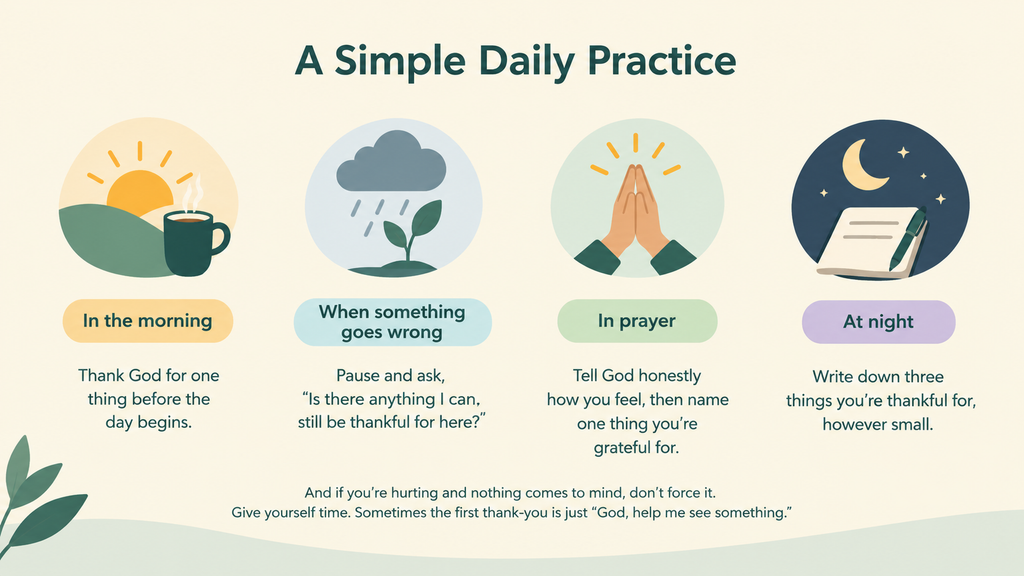
If you’d like somewhere to start, here’s a rhythm you can try:
– In the morning: Thank God for one thing before the day begins.
– When something goes wrong: Pause and ask, “Is there anything I can still be thankful for here?”
– In prayer: Tell God honestly how you feel, then name one thing you’re grateful for.
– At night: Write down three things you’re thankful for, however small.
And if you’re hurting and nothing comes to mind, don’t force it. Give yourself time. Sometimes the first thank-you is just “God, help me see something.”
Yes, It Is Possible
So, is it really possible to give thanks in all circumstances?
I believe it is—not because life is always easy, our prayers are always answered as we hope, or our hearts are always full of joy. It’s possible because gratitude is not the absence of pain. It’s a way of remembering God’s goodness even when we don’t understand our circumstances.
We can grieve and still pray. We can feel uncertain and still trust. We can face difficult days and still find reasons to thank God.
You don’t have to change everything about your situation today. Start with one small step. Remember one blessing, offer one honest prayer, or thank God for His presence in the middle of your struggle.
And if all you can pray today is, “God, help me,” that’s a place to begin, too.
What is one thing you can thank God for today, even in the middle of something difficult?
